Politics was not always a career. That should be obvious, but in an age that mistakes the familiar for the natural, it is worth stating plainly. Ancient polities had rulers, magistrates, councillors, tribunes, and functionaries in abundance. What they did not yet possess, at least not in the modern democratic sense, was the full-time electoral specialist: the figure whose primary craft is neither war, law, trade, nor philosophy, but the acquisition and retention of office itself.
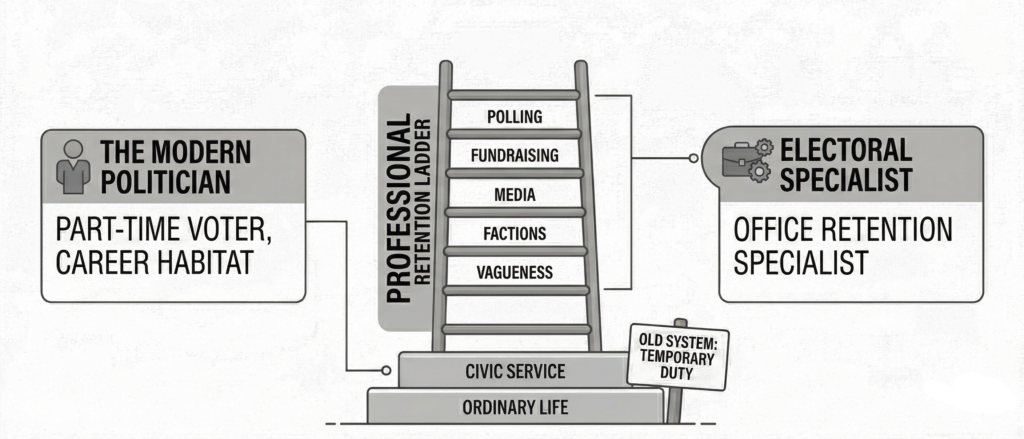
There was a time when office was burdensome, temporary, even faintly indecent: a duty imposed, a burden carried, a season of service endured before one returned to ordinary life. A citizen might leave his farm, his workshop, his court, his study, or his ship; attend to the affairs of the city; make a judgment or defend a measure; and then go back to being what he had previously been. Politics interrupted life. It was not yet life’s permanent occupation.
The modern world inverted that arrangement. It turned politics from interval into profession, from duty into ladder, from civic episode into salaried identity. That is one of the least examined and most consequential revolutions in democratic history. We are forever told that democracy means elections. Very well. But elections, by themselves, do not require a permanent caste of electoral specialists. Voting is ancient enough. Representation, in one form or another, is old enough. What is much newer is the figure of the full-time politician: the man or woman whose chief expertise is not agriculture, law, medicine, engineering, philosophy, or war, but the acquisition and retention of office itself.
That creature is not a law of nature. He is a historical invention. Bernard Manin’s useful reminder is that representative government did not simply emerge as democracy in perfected form; it arose as a distinct arrangement that only later came to wear democratic legitimacy so completely that the difference began to disappear from public memory.
He is also a very particular invention. Kings claimed birth, generals claimed force, priests claimed revelation, aristocrats claimed breeding. The professional politician claims procedure. That is what makes him harder to see. He does not present himself as a ruler in the old, vulgar sense, but as a neutral servant of democratic necessity. Yet his real craft is neither truth nor judgment nor production nor creation. It is navigation: of factions, platforms, donors, moods, committees, cameras, and the permanent low-grade warfare of organized ambition. He is modern not because he is wiser than older rulers, but because he has learned to convert the language of equality into a durable habitat of managed inequality.
And like many historical inventions, he arrived dressed as progress. Max Weber later gave the transformation one of its clearest formulations: there are those who live for politics and those who live off it. The modern careerist learns, with professional fluency, to do both, but especially the second.
From civic duty to career ladder
The earliest defenders of popular rule did not imagine politics as an industry populated by handlers, tacticians, broadcasters, donors, pollsters, “communications teams,” and special advisers who speak in the bloodless dialect of managed sincerity. They imagined citizens sharing in rule, however imperfectly, however narrowly defined the citizen body may have been. Their democracies were compromised, exclusionary, provincial, and often absurd. But they had not yet perfected the truly modern absurdity: the citizen who participates once every few years and is then instructed to return to sleep while the professionals take over.
The old republics had many vices. What they did not yet possess was a mature political career path. The career path matters. It changes the soul of the enterprise. Once politics becomes a ladder, it ceases to reward candour and begins to reward calibration. A citizen may afford to speak frankly because he has a life to return to. A careerist cannot. He must survive the next party vote, the next leadership whisper, the next donor dinner, the next media cycle, the next factional ambush, the next internal betrayal disguised as collegial concern. In such a world, truth becomes expensive. Vagueness is safer. Loyalty is bankable. Memory is selective. Conviction is rationed.
The result is a peculiar species of human being: one who speaks constantly of principle while calculating incessantly; who invokes the public while scanning the room for patrons; who calls every compromise “responsible” and every retreat “realistic”; who can survive almost any humiliation except private unemployment.
One sees the same logic in the way parliamentary salaries are defended. The usual justifications are familiar: the work is demanding, corruption must be discouraged, campaigns create debt, office is unstable, and re-entry into ordinary employment is uncertain. Some of this is true. But the deeper point is more revealing. These are precisely the arguments one makes when politics has ceased to be a civic interval and become a protected career track. The scandal is not that legislators are paid. It is that parties claiming to speak for ordinary workers so rarely ask whether representatives should remain materially nearer to the lives they claim to interpret. Once office is rewarded at a level far removed from median life, representation quietly acquires the atmosphere of exemption. The politician does not merely speak for the public. He begins to live apart from it.
This is not because politicians are uniquely wicked. It is because professions shape character. A man trained as a surgeon begins to see the body in one way. A man trained as an architect begins to see the city in another. A man trained in career politics begins, sooner or later, to see every question as an electoral one. That is the corruption, and it often arrives long before money does.
Party systems and industrial modernity
The professional politician did not descend from heaven, or crawl from hell, fully formed. He was manufactured by modernity. Industrial society required scale. Scale required organization. Organization required parties, machines, committees, whips, platforms, organizers, caucuses, brokers, and the managerial priesthood of modern politics. The village notable and the occasional orator were no longer enough for mass electorates, national newspapers, railways, trade unions, census states, centralized treasuries, modern armies, and industrial capitals. Politics had to be coordinated at volume.
In Western Europe especially, the expansion of suffrage and the social upheavals of industrial modernity enlarged the field of politics while narrowing the routes into it. More people entered political life; but they increasingly did so through parties, legal careers, administrative roles, labour organizations, and institutional ladders that rewarded continuity over interruption. And so the party became not merely an association of beliefs, but a mechanism of selection and promotion. It trained speech habits, distributed opportunities, punished deviation, sorted the useful from the sincere, and taught a generation of aspirants the first commandment of institutional survival: do not become inconvenient before you become indispensable.
This was presented, and often honestly believed, as democratic progress. In one sense it was. Parties mobilized millions. They organized workers. They spread literacy of a sort. They transformed scattered grievances into national programs. They gave structure to ideological conflict.
But they also created a new internal labour market: politics as profession, politics as staircase, politics as livelihood. Once that happened, ambition ceased to be an incidental feature of public life and became its operating fuel. Robert Michels gave this tendency its bleak formula in the “iron law of oligarchy”: once organizations grow, leaders, staff, and procedural specialists begin accumulating advantages that ordinary members cannot easily match, until democratic forms and oligarchic habits begin living under the same roof (Michels, 1915). The party no longer merely represented interests. It manufactured careers. Michels shows how organization oligarchizes. Mosca sharpens the insult: every society tends toward a political class. The democratic question is not whether minorities rule in some sense, but whether that ruling minority can be continually broken open, corrected, and replenished from below.
And this machinery now survives in a weakened social landscape. In many democracies, formal party affiliation has declined even while parties remain the principal gatekeepers of office. That contrast matters. It suggests that the party has not disappeared because citizens still inhabit it as a shared civic home, but because it continues to function as an electoral sorting machine. Social attachment thins; professional dependence remains. The party becomes less a living association and more a career platform.
The route varies by system, but the result is recognizably similar. In parliamentary orders, the careerist climbs through youth wings, staff roles, local councils, party lists, committees, caucuses, and ministerial ladders until he becomes a creature almost entirely incubated by political machinery. The system prefers them young. Not because youth is a vice, but because early entry lets politics colonize a life before ordinary life has had much chance to harden it. Sanna Marin is useful here less as a moral target than as a clean specimen of the modern route: her political rise began early in municipal politics, she became chair of the Tampere city council at 27, entered national cabinet as transport minister in June 2019, and became Finland’s prime minister in December 2019 at 34, not by direct elections. The deeper point is structural. A politics that recruits early, promotes internally, and rewards those who have spent more of their adult life inside party machinery than outside it should stop congratulating itself on merit. It is not discovering talent. It is growing its own greenhouse crop.
In presidential systems, the path is often noisier and more personalized, donor networks, media recognition, executive branding, legal theatrics, governorships, senatorial visibility, factional alliances, but the outcome is no less professionalized. Different constitutional costumes, same anthropological result: a class of people increasingly trained not in the disciplines of ordinary life, but in the acquisition, retention, and theatrical management of office.
One begins at youth wing, internship, local council, assistantship, committee seat, parliamentary list, ministerial junior role, cabinet berth, leadership bid, foundation, consultancy, memoir, lecture circuit, board membership, and perhaps a final burial beneath flattering editorials about “lifelong service.” A monarchy of blood was abolished and replaced, in too many places, by a monarchy of networking. The vocabulary became democratic. The structure remained dynastic.
It also became curiously self-referential. A politics supposedly devoted to the nation began increasingly to recruit from those who had done little outside politics. The number of people whose principal qualification for office was previous proximity to office steadily increased. The citizen was told he lived in a meritocracy. He was in fact governed, with growing frequency, by those who had mastered an enclosed game. The old aristocrat at least had the honesty to inherit. The modern political climber calls his ascent public virtue.
One need not romanticize the nineteenth-century machine to see the pattern. Tammany Hall, for instance, was not simply municipal corruption in picturesque costume. It was an early demonstration that mass participation and machine control could grow together: committees, patronage, local loyalty, and centralized discipline feeding one another while democratic language remained intact.
Media and the manufacture of performance
Then came the next mutation: politics under mass media. Once power had to be seen as well as exercised, the politician changed again. Radio rewarded voice. Television rewarded composure. The televised age elevated not only conviction, but appearance; not only argument, but timing; not only intelligence, but facial management. A new premium was placed on seeming authoritative for ninety seconds at a time.
It is difficult to exaggerate what this did to public life. The Kennedy–Nixon debates are remembered for good reason. They revealed with almost comic clarity that politics had entered the age of optics: the same event could produce different judgments depending on whether one heard it or saw it, and performance began competing openly with argument as a route to authority.
The politician became performer, the speech became product, the debate became theatre, and the electorate became audience. It was no longer enough to think; one had to emote on cue. It was no longer enough to judge; one had to signal. It was no longer enough to speak; one had to land lines. The great enemy was not falsehood alone, but boredom. A serious civilization ought to fear the boredom standard. Once public life is organized around retaining attention, demagogy stops being an accident and becomes a market advantage.
The professional politician adapted beautifully. Why wouldn’t he? He is the most adaptable organism in the democratic zoo. He learns the optics of concern, the choreography of outrage, the ritual posture of humility, the synthetic intimacy of first-name populism. He kisses babies, mispronounces factory jargon, appears in rolled-up sleeves to indicate solidarity with labour he has never performed, and refers to “hard-working families” with the desperate repetition of a man praying to a god he does not believe in. Then technology sharpened the blade.
The data-driven age did not merely modernize politics; it degraded it. Voters became profiles. Citizens became segments. Convictions became testable messages. Fear, resentment, vanity, tribal reflex, and status panic could be measured, targeted, and harvested with commercial precision. The campaign stopped resembling democratic persuasion and began to resemble behavioural advertising with patriotic wallpaper.
The next mutation was almost comic in its indecency. Politicians no longer needed merely to appear on a stage; they could now franchise their own presence. Narendra Modi and Jean-Luc Mélenchon both used holographic projection to address multiple crowds at once, as though representation itself had become a kind of political telepresence. The trick is revealing. A leader who can appear in five places at once is not more democratic. He is simply more scalable. The body becomes a broadcast asset. Add to this the microtargeting logic exposed so crudely in recent campaigns: different voters receiving different messages, not in a shared public sphere but in private streams engineered for reaction. At that point politics stops pretending to be collective persuasion and becomes something closer to customized mood management.
We flatter ourselves that this is advanced politics. It is more accurate to call it organized pandering. In the older, cruder age, a politician lied to the crowd. In the newer, more sophisticated age, he lies differently to each subsection of the crowd and calls this responsiveness.
The rise of political advisers
At some point the politician ceased even to be the sole author of his own evasions.
The rise of the adviser class is one of the great quiet coups of modern governance. The speechwriter, strategist, media coach, polling analyst, narrative manager, opposition researcher, crisis consultant, image repairman, digital operative, and “special adviser” together form the second nervous system of career politics. Some are talented. Some are charlatans. Most are unelected. All are influential. Nor is this merely conspiracy talk. In contemporary government the adviser layer is often formalized in plain sight. In Britain, for example, special advisers are explicitly described as adding a political dimension to ministerial support and helping represent ministers’ views across government and media.
The public imagines that it is governed by ministers, presidents, prime ministers, and parliamentarians. Increasingly, it is governed by a ventriloquist arrangement in which the visible office-holder is merely the face attached to a backstage apparatus of interpretation, filtration, rehearsal, and spin. This produces a double fraud.
First, the politician pretends to personal mastery over subjects he barely understands. Second, the adviser pretends to be a neutral technician rather than a political actor without democratic mandate. Between them emerges the great modern fiction of professional politics: that democratic legitimacy can somehow be preserved while judgment is outsourced to a court of handlers whose names the public scarcely knows. The result is language so sterilized that one suspects it has been ironed. Nobody says “we failed”; they say “mistakes were made.” Nobody says “we panicked”; they say “the situation evolved rapidly.” Nobody says “we sold access to the rich”; they say “stakeholder engagement was ongoing.” The sentence is no longer written to illuminate reality. It is written to survive contact with headlines.
Professional politics thus develops its own dialect: bloodless, evasive, managerial, strangely post-human. It is the language of permanent caution. It seeks not to tell the truth, nor even persuasively to conceal it, but to fog the terrain until responsibility cannot find its address.
This is why the modern politician so often appears both hyper-visible and curiously unreal. He is everywhere and nowhere. He speaks constantly and says almost nothing. He is promoted as leader while functioning as instrument. His image is sold as authenticity after passing through six layers of messaging review. He is, in short, professionalized.
The invention can be undone
That matters because what is invented can be redesigned.
The professional politician likes to present himself as the mature endpoint of democratic development, as though history marched from monarchy to aristocracy to party operative with a media adviser and a polling dashboard. It did nothing of the kind. Democracy did not culminate in the consultant-managed careerist. It merely tolerated him, then normalized him, and finally began mistaking him for democracy itself. The problem is not that representation exists. Large societies will always need forms of delegation, mediation, and institutional design. The problem is that delegation has been professionalized, monetized, theatricalized, and made into a career habitat. We no longer ask citizens to govern. We ask them to choose which specialist class will govern them while claiming to speak in their name. This is called realism. It is actually surrender.
To say that politics became a profession is not to indulge nostalgia for some lost republic of virtuous cobblers and philosophic blacksmiths. No such paradise existed. Human beings were vain, corruptible, tribal, and self-deluding long before focus groups and party headquarters. The point is not that the past was pure. The point is that the present has institutionalized impurity and renamed it normal.
Office became a career ladder. The ladder produced a class. The class learned to reproduce itself. And the public was informed that this reproduction was democracy. It is not. It is a system in which the struggle for office has become a vocation in itself, increasingly detached from the ordinary disciplines of life and ever more insulated by party machinery, media ritual, and advisory priestcraft. That arrangement was made by human beings. It can be unmade by them as well.
The first step is intellectual honesty: to stop speaking of the professional politician as though he were the natural guardian of democratic life, and to start speaking of him as what he is, a historical artifact of modern power. And history, thank heaven, is not a prison.
Pedro Aibéo
Sydney, 28.03.2026