Democracy likes to congratulate itself on elections.
This is understandable. Elections are preferable to succession by blood, rule by uniform, or instruction from a hereditary imbecile in ceremonial dress. They allow governments to be dismissed without civil war. They create at least the possibility of accountability. They remind rulers, now and then, that the public is not livestock. All that is true. It is also incomplete. For elections do not merely discipline power. They also shape it. They do not simply choose office-holders after the fact; they train office-seekers beforehand. They reward certain habits of mind, certain reflexes of speech, certain ways of seeing the world. And once politics becomes a profession, elections cease to be periodic tests of public trust and become the atmospheric condition in which the professional politician lives, breathes, calculates, flatters, evades, survives, and decays.
The sentimental theory says elections keep politicians honest. The adult theory is harsher: elections teach politicians which kinds of dishonesty are electorally survivable.
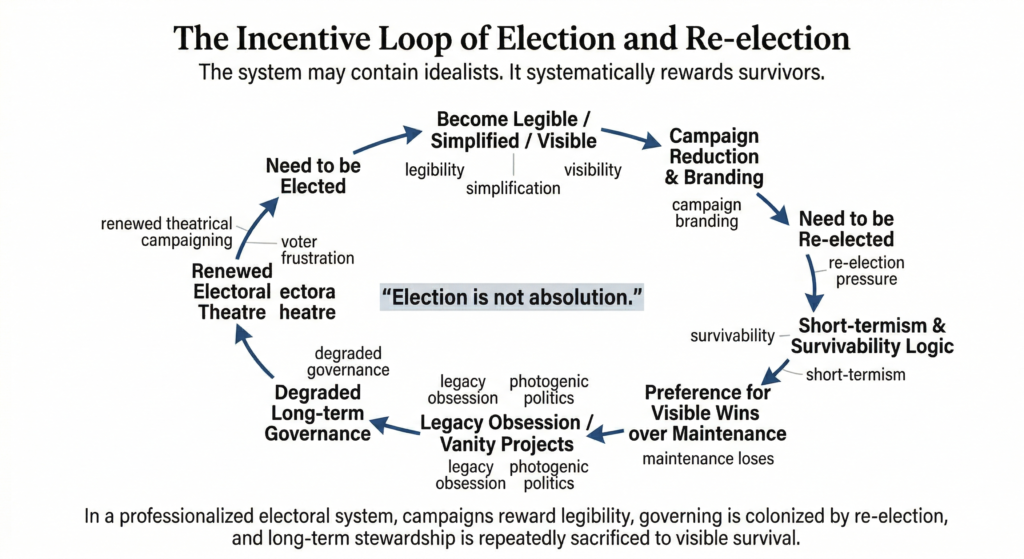
That is why the old formulation, brutal in its simplicity, remains so useful: first to be elected, second to be re-elected. One could put the point in the colder language of electoral theory and say that modern representative systems reward those who learn to maximize support under competitive conditions. But stripped of academic deodorant, the meaning is simpler. Everything else, however nobly printed in manifestos and murmured from lecterns, must pass through those twin gates. The system may contain idealists; it systematically rewards survivors.
The candidate may enter wanting justice, prudence, reform, dignity, and the common good. Very touching. The institution replies with a simpler syllabus: win, remain, repeat. This is not cynicism. It is mechanics.
First to be elected
To be elected, one must first become legible. Not wise. Not necessarily competent. Not necessarily serious. Legible.
One must be seen, heard, branded, repeated, simplified, flattened into a form suitable for circulation. A person with a layered understanding of fiscal policy, ecological breakdown, administrative law, housing markets, public health, municipal procurement, and the sociology of loneliness is of no immediate use to the electoral machine unless he can compress all that into a slogan fit for a poster and a sentence fit for television. Politics therefore begins with reduction. The candidate learns, early and well, that complexity does not mobilize. Nuance does not travel. Caution looks weak. Qualification sounds evasive. Honest uncertainty resembles incompetence. A sentence beginning with “on the one hand” is already halfway to defeat. So the world must be cut into digestible moral theatre: builders versus blockers, patriots versus traitors, the people versus the elite, the future versus the past, common sense versus ideology. What cannot be dramatized will likely not be heard. What cannot be heard will not be rewarded. And what is not rewarded will soon be abandoned. The candidate also learns another lesson: voters are not encountered as citizens in the thick, demanding sense of the word, but as electoral aggregates to be aroused, reassured, segmented, and shepherded. Their fears are mapped, their vanities courted, their prejudices tested, their resentments translated into turnout models. A public becomes a target population. A conviction becomes a message. An argument becomes a vehicle. And so before office has even been won, the deformation has begun. The aspiring representative discovers that self-presentation matters as much as self-government, that tone can outweigh truth, that visibility is not the by-product of politics but one of its main currencies. He must not merely persuade; he must persist in view. He must not only hold positions; he must manage impressions. He must not simply appeal to reason; he must avoid triggering the kinds of reason that slow enthusiasm. This is why election campaigns so often feel like open insults to public intelligence. They are not failures of communication. They are highly adapted forms of it.
Then to be re-elected
Once elected, the sentimental citizen imagines that governing begins. It does, after a fashion. But the professional politician quickly learns that government is often just campaigning conducted by other means. Every decision now exists under a double aspect: what it does, and what it looks like before the next vote. Every reform is shadowed by timing. Every fiscal measure is filtered through mood. Every necessary pain must be weighed against the possibility that someone else, less scrupulous and more theatrical, will convert that pain into a weapon.
Re-election does not merely influence policy. It colonizes it.
This is what outsiders, especially clever outsiders, often fail to grasp. They imagine that the politician wakes in the morning and asks: what is right? A touching fantasy. The actual professional asks, more often than not: what is survivable? Which fight can be won? Which compromise can be disguised? Which delay can be endured? Which retreat can be sold as prudence? Which lie is too large, which evasion sufficiently fogged, which omission unlikely to make the evening news? Even decency becomes tactical under such conditions. Japan’s 1994 electoral reform is a useful warning against democratic superstition. The old system, rooted in arrangements that had operated since the age of universal manhood suffrage in 1925, was replaced amid the breakdown of the old order. Many hoped the new rules would produce cleaner politics. Gerald L. Curtis was too serious for that fantasy. Institutions matter, yes. But politicians do not cease being adaptive mammals because the ballot paper has been redesigned. They learn the new choreography. They recalculate alliances, visibility, survival, and personal advantage under altered constraints. The lesson is universal: reforming electoral mechanics may change the battlefield, but it does not by itself abolish career instinct. Change the rules and the careerist simply rents a new house. (Curtis, 1999)
The politician may know that a pension system is unsustainable, that climate adaptation requires sacrifice, that health systems need dull structural repairs rather than triumphant announcements, that local government should invest in pipes, insulation, maintenance, staffing, and prevention instead of photogenic nonsense. He may know all this perfectly well. But knowledge is not the same as incentive. If the benefit of a painful reform arrives in twelve years and the political cost arrives next Thursday, the electoral system has already whispered its preference. And the whisper is usually obeyed. This is not theoretical. In Britain, David Cameron’s promise of an in-out referendum on the European Union was made under party-electoral pressure and tactical short-term calculation; the consequences far outlived the campaign logic that produced it. Electoral survival generated a decision whose constitutional and economic afterlife would be borne by everyone else. Short-termism is not stupidity. It is rational behaviour. That point deserves emphasis because moral scolding so often misses it. One can lecture office-holders about courage, vision, honesty, stewardship, and sacrifice until the lecture hall collapses from boredom. But if the structure continues rewarding what is immediate, visible, fundable, and survivable, then sermonizing becomes merely another decorative ritual of decline. The professional politician does not need to be a fool to behave badly. He needs only to be adaptive. This is where the best institutional scholarship is less sentimental than democratic rhetoric. Politics unfolds in time, but electoral incentives compress time. The future appears as a cost centre, the present as a battlefield, and the next election as a cliff edge. Long-term investment therefore becomes politically fragile not because rulers are incapable of understanding it, but because they must repeatedly survive nearer horizons before they are permitted to care about distant ones.
Consider the obvious. Electoral cycles are short. Public attention is intermittent. Media incentives are immediate. Crises are dramatic. Maintenance is invisible. Prevention produces non-events, and non-events do not cut ribbons, generate campaign footage, or justify heroic self-description. If a bridge does not collapse because someone quietly funded inspections and repaired corrosion ten years in advance, no minister gets to stand in front of the saved bridge declaring victory over absence. If a hospital is properly staffed so that catastrophe never occurs, the cameras do not arrive. If a housing strategy prevents a future emergency, no one feels the narcotic thrill of rescue. The professional politician therefore gravitates toward what can be announced, displayed, inaugurated, branded, and claimed. The grammar of governance changes accordingly. Policy becomes a series of “deliverables,” “wins,” “packages,” “responses,” “initiatives,” and “roadmaps” — that miserable managerial liturgy by which seriousness is replaced with bullet points. The point is not merely to govern but to generate visible proof of governing. One begins to prefer the kind of act that can be narrated over the kind that quietly works. This is fatal to long-term civilization. Take climate change, the perfect enemy of the professional political mind. It is cumulative, planetary, dispersed, technical, intergenerational, and full of deferred consequences. It demands that present voters bear costs for future strangers, that administrations invest in resilience whose full value will be recognized only when their authors are dead or forgotten, and that leaders speak honestly about limits, trade-offs, and delayed gratification. In other words, it demands almost everything the electoral career structure is worst at supplying. So what do we get instead?
Ceremonial urgency. Sincere speeches with fraudulent timelines. Targets set beyond the lifespan of the present office-holder. Action plans. Summits. Declarations. Branding exercises. Green rhetoric wrapped around carbon reality. The politician hugs the future in public and mortgages it in committee. The pattern is familiar: targets are announced for 2035, 2040, or 2050 by office-holders who may not survive the next reshuffle, let alone the deadline. Again, this is not because every office-holder is secretly a nihilist. It is because the incentives punish those who behave as trustees of the long term while rewarding those who behave as managers of the immediate mood. The same pattern appears everywhere: tax giveaways before elections, deferral of infrastructure pain, underinvestment in maintenance, avoidance of housing reform, magical thinking about demographic change, cowardice on pensions, theatrical severity in policing paired with strategic cowardice on root causes, spending cuts where the victims are diffuse and benefits to image are immediate. The common feature is not wickedness alone. It is temporal compression.
Professional politics shrinks the future until it can fit inside a campaign cycle.
The horizon narrows
This narrowing has moral consequences. A statesman, in the demanding sense, must be willing to disappoint the present in order to protect the future. The professional politician, by contrast, is trained to fear disappointment as an electoral event. He therefore becomes exquisitely sensitive to present irritation and strangely numb to future ruin. He is brave in rhetoric and timid in scheduling. He will speak magnificently of posterity while ensuring that nothing electorally dangerous occurs before the next vote. He will launch consultations, commissions, forums, dialogues, green papers, white papers, listening exercises, strategic reviews, and all the other anaesthetics of democratic postponement. Delay acquires ethical costume. Cowardice becomes stakeholder engagement. And because this behaviour is ubiquitous, it starts to feel normal. The citizen, seeing so much evasive choreography, lowers his expectations. He ceases to ask whether the system produces farsighted judgment and asks only whether his preferred faction can perform the evasions with slightly better manners. That is how standards collapse in free societies: not always through terror, but through adaptation.
Legacy obsession
Short-termism would be one thing if it produced mere drift. But the professional politician, being human and often worse than that, wants more than survival. He wants remembrance. He wants a mark. This is where electoral logic joins hands with vanity and gives birth to one of the most expensive afflictions of public life: legacy obsession.
No politician wants his tenure summed up by the sentence, “Things functioned slightly better and the drainage held.” There are no memoir chapters titled A Quiet Improvement in Preventive Maintenance. No flattering documentary lingers over properly funded insulation retrofits, competent staffing ratios, repaired sewage systems, or the successful avoidance of future collapse. Posterity, or rather the politician’s fantasy of posterity, demands symbols.
So rulers begin to seek monuments to themselves, whether literal or administrative. A signature reform. A giant building. A summit. A doctrine. A plaza. A museum. A new headquarters. A bridge. A cultural icon. An urban megaproject. Something large enough to photograph and durable enough to carry a name through retirement and beyond.
The seduction is obvious. Maintenance belongs to anonymity; monuments belong to biography.
This is why the vanity project is not an accidental excess of the system but one of its purest expressions. It satisfies every craving at once: visibility, grandeur, media attention, donor interest, historical association, ribbon-cutting ceremony, institutional ego, and the delicious illusion that the politician has transcended ordinary administration and entered the realm of legacy. The Elbphilharmonie is useful here precisely because it is not an isolated scandal but an emblematic one. It belongs to a whole species of project beloved by political vanity: the monumental cultural gesture that permits governing classes to admire themselves in architectural form. The point is not that the building lacks artistic merit, nor that large civic works are always folly. The point is that prestige megaprojects are almost tailor-made for electoral biography. They condense ambition into an image. They allow leadership to pose as vision. And when costs rise, deadlines slip, and warnings accumulate, retreat becomes politically harder precisely because the object has already been bound to legacy. Such projects are always defended in elevated language. They symbolize renewal. They project confidence. They place the city on the map. They attract investment. They honour culture. They inspire the future. Very moving. One almost forgets to ask whether the same public money might have relieved quieter and more pressing needs whose only defect is that they lack glamour.
This is the central obscenity of legacy politics: the photogenic devours the necessary.
A school roof repaired in time is not a legacy. A heating network modernized is not a legacy. A procurement system made less corrupt is not a legacy. A dull but effective housing policy is not a legacy. A sewage upgrade is certainly not a legacy unless one is campaigning in a civilization of adults, which regrettably we are not. So politicians, especially those nearing the end of a career or smelling the fragility of office, are drawn toward visible enormity. If they cannot solve history, they can at least decorate it. If they cannot reform the structure, they can pose in front of it. If they cannot be loved, they can be remembered. And if remembered critically, well, remembered nonetheless.
The vanity project is often just mortality wearing a hard hat.
Why maintenance loses
There is a brutal asymmetry here. Maintenance is almost always more important than novelty. But novelty is almost always more legible than maintenance.
To keep a society functioning requires endless acts of repair: water systems, schools, clinics, transit lines, insulation, staff retention, bridge reinforcement, sewage renewal, archives, parks, stairwells, public housing retrofits, safety checks, boring competence, preventive attention, humble foresight. None of this is sexy. All of it matters. The megaproject, by contrast, is a gift to vanity. It condenses complexity into an image. It allows officials to stand before a model and point. It creates a binary drama: forward-looking versus backward-looking, ambitious versus timid, world-class versus provincial. It turns prudence into cowardice and caution into a lack of imagination. The politician then appears as the only adult daring enough to dream big, while the sceptic is cast as a miserly clerk opposed to progress itself.
This trick works because maintenance is difficult to dramatize. A repaired school ventilation system may save lives, but it does not produce a glamorous opening ceremony. A municipality that prevents flood damage through invisible upgrades earns little applause because catastrophe successfully avoided lacks spectacle. The politician gets no triumphant photograph standing beside a pipe that did not burst. So the incentives are obvious. Spend where cameras gather. Delay where only future gratitude might arise.
And because future gratitude is electorally weak, it is routinely outbid by present theatre. Voters are not innocent, but they are not the main culprits either.
Election is not absolution
At this point some stern defender of electoral orthodoxy usually clears his throat and says: but politicians only respond to voters. If the public rewards spectacle, that is the public’s fault. If citizens prefer charisma to maintenance, monument to sewage, promise to arithmetic, who are politicians to deny them?
This argument contains a grain of truth and several sacks of evasion.
Yes, voters are often susceptible to theatre. Human beings are vain, frightened, bored, impatient, tribally suggestible, and readily seduced by confidence. We do not cease being apes because we have a constitution. But the public does not invent its own political environment from thin air. It responds within structures already saturated by media incentives, party competition, donor influence, short electoral horizons, attention scarcity, and a professional class trained to communicate through oversimplification. Citizens are episodically invited into politics after professionals have already staged the scene. Then we scold them for noticing the lights. Moreover, the public frequently does want boring competence, honesty, and long-term prudence. It is simply bad at locating them in a system that systematically over-rewards performance. A voter may desire seriousness and still end up choosing theatre because theatre is what the system makes visible. He may detest vanity projects and still be offered only differently branded vanity. He may crave maintenance and be given a campaign about national destiny. The citizen is therefore implicated, yes, but not sovereign in the matter. They too live inside the incentive machine. Election is not absolution. That should be written above every parliament in letters large enough to embarrass the well-dressed. On 4 February 2021, the BMJ published Kamran Abbasi’s editorial “Covid-19: Social murder, they wrote — elected, unaccountable, and unrepentant.” The phrase was severe and deserved to be. A ballot is not a moral laundering device. Citizens vote under fog, theatre, branding, party sorting, partial information, and institutional incentives they did not design. They do not grant a sacramental licence to office-holders to gamble with preventable death and then retreat behind the phrase “the public chose us.” When elected governments knowingly tolerate avoidable mass harm in order to protect markets, careers, or narrative control, election does not purify the act. It only reveals how cheaply mandate is used as detergent.
Re-election as permanent temptation
There is another degradation worth naming. Re-election does not merely shorten horizons; it changes the inner life of the office-holder.
He begins to interpret every criticism through the lens of threat, every colleague through the lens of rivalry, every reform through the lens of ownership, every crisis through the lens of blame management, every institution through the lens of utility. He becomes defensive where he should be reflective, theatrical where he should be exact, proprietary where he should be temporary. The office-holder no longer simply governs under electoral pressure, but internalizes it as a mode of being. At that point, the office has entered the bloodstream. This helps explain why even intelligent and initially decent people so often emerge from prolonged political careers sounding like badly programmed public-relations avatars. They are not always lying in the crude sense. They are living inside a continuous act of strategic self-preservation. They no longer ask what language best illuminates reality, but what language best preserves room for manoeuvre.
That is why phrases such as “we are focused on delivery,” “hard choices,” “moving forward,” “working families,” “difficult context,” and “lessons have been learned” appear with such dreary regularity across parties, countries, and ideologies. It is the shared language of the re-electable self. It does not clarify; it insulates.
The architecture of mediocrity
The result of all this is not usually tyranny. Tyranny at least has the honesty of open domination. The result is more often something drearier: the systematic production of mediocrity. Not stupidity, exactly. Not always corruption in the crude envelope-stuffed sense. Something worse in its own way: a political environment in which ambition outruns judgment, optics outrun truth, monument outruns maintenance, and the future is repeatedly sold for the price of present manageability. The professional politician becomes expert at movement without direction, activity without resolution, announcement without repair, and legacy without stewardship. He appears indispensable while being, in structural terms, a rather predictable output of the electoral career machine. And because the machine renews itself, the pathology reproduces. Young candidates arrive denouncing old cynicism and are soon forced to learn its grammar. Reformers enter promising candour and discover that candour polls badly. Outsiders run against the class and, if successful, are quickly absorbed by the incentives of class reproduction. New faces, old choreography. The problem is not that politicians are uniquely vain, cowardly, short-sighted, or addicted to applause. Many human beings are all those things. The problem is that the professional electoral system takes those familiar weaknesses and wires them into public authority. It elevates them, rewards them, stabilizes them, and then acts surprised when public life begins to resemble a contest between self-advertising mammals with poor temporal horizons. That is why election and re-election cannot be treated as innocent procedures floating above power. In a professionalized system, they become organizing imperatives. They decide what kinds of people rise, what kinds of truths can be spoken, what kinds of projects are pursued, what kinds of futures are sacrificed, and what kinds of vanity can be financed in the name of the public.
Pedro Aibéo
Woodfordia, Australia, 07.04.2026