In April 2026, while in Australia, I went to the Blue Mountains to visit Ian Mackenzie, a maker of uilleann pipes. I had brought my pipes because they were not working properly. Or, more accurately, they were working in that mysterious way bagpipes sometimes work: almost, but not quite; alive, but temperamental; full of promise, but resisting every simple explanation.
The problem was the reed.
For those who do not play pipes, the reed is a tiny object with enormous authority. It decides whether the instrument speaks, screams, whispers, refuses, or suddenly becomes beautiful. A whole bagpipe can be silent because of a few millimetres of cane.
Ian took the reed, looked at it, and immediately noticed something strange.
The eye was tiny.
In reed-making, the “eye” is the small opening at the end of the staple, the point through which air begins its transformation into sound. Ian compared it with other reeds on his bench: Northumbrian reeds, smallpipe reeds, his own uilleann pipe reeds. Mine would not even allow the same tools through.
He said he had never seen an eye that small.
This became the first lesson of the visit: an instrument is not a collection of interchangeable parts. A reed belongs to a chanter in a very particular way. The pitch of the reed is related to the pitch of the pipe, but it is not the same thing. The internal volume of the reed, the opening of the blades, the way it sits in the reed seat, the pressure, the octave balance — all of it matters.
A few millimetres can change the world.
Ian explained that sliding the reed in and out of the chanter can help with tuning, but it can also create new problems. The second octave may go out. The first octave may behave differently. A reed can be sharp in one register, flat in another, loud in one position, unstable in another. There is, he said, only one true position where the instrument properly settles.
This is the kind of knowledge that is hard to write down. It lives in fingers, ears, habits, failures, and benches covered with old reeds.
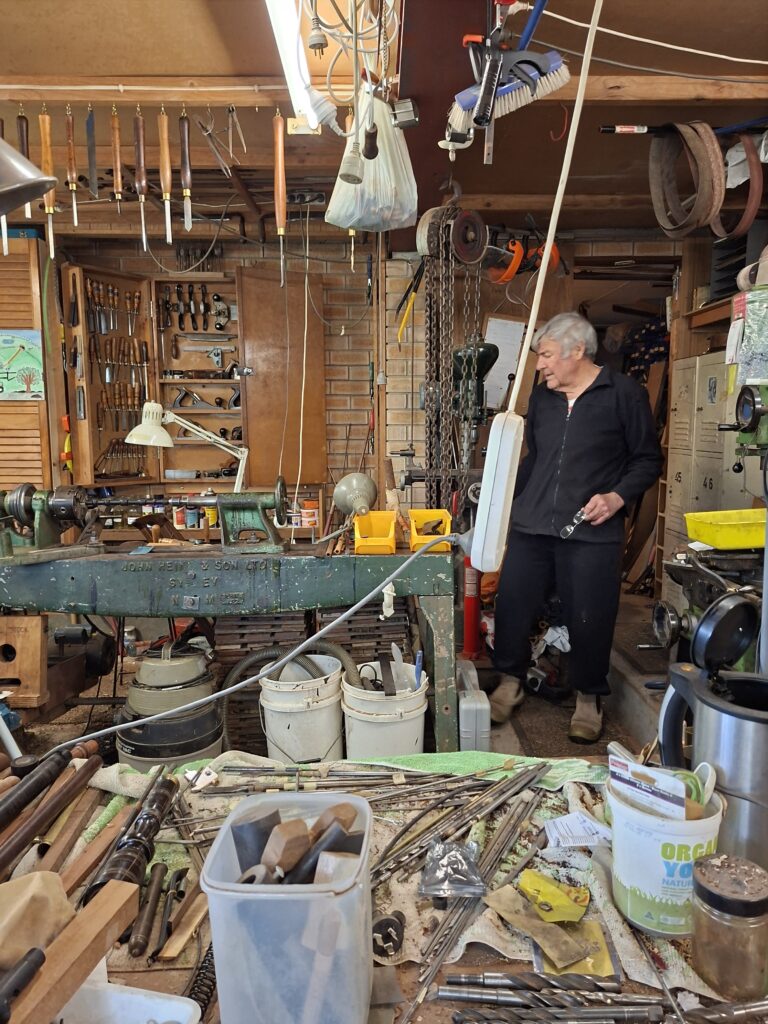
On the table were reeds that had been lying around for years, chanters of different woods, threads, waxed cotton, tools, bits of tape, and coffee. Birds came down outside to be fed. At some point, Ian talked about cheese being good for them because of the calcium, but not meat, because it could damage their beaks. It was one of those conversations where everything belonged: birds, reeds, surgery, ships, drones, Galician music.
The pipes slowly came back to life.
One reed was too aggressive. Another was too sharp. Another had a softer tone. Ian adjusted the binding, shifted the reed, tested the pressure, listened to the second octave, and explained what was happening. My own playing was rusty; I had not practised enough, and I could feel it in my fingers. Still, one reed began to work well enough.
Not perfect. But playable.
And sometimes, in the life of a travelling musician, playable is a miracle.
Then we turned to the Galician gaita.
I had brought a set by Carlos Galván, and also a 3D-printed student gaita made by Ricardo Coelho. Ian’s reaction to the 3D-printed instrument was wonderful. He was surprised by how well it played. The reed was adjustable, stable, and powerful. The sound worked. The material may not have had the romance of wood, but the instrument did what an instrument must do: it sounded alive.

This opened another small theme of the visit: tradition does not necessarily die when new materials appear. Sometimes it travels through them.
A wooden chanter feels warmer in the hand. It has weight, history, touch. But a 3D-printed pipe can be affordable, stable, and accessible to students. For a music tradition to continue, it needs both: reverence and invention.
Ian had also played Galician pipes before. He remembered people in Sydney, Spanish and Galician musicians, restaurants, old meetings, magazines whose names had almost disappeared from memory. He spoke of the gaita with affection. For him, it was one of the great bagpipes of the world, capable of semitones, flexibility, and musical richness far beyond the stereotype of what bagpipes can be.
That was another important point. Bagpipes are often misunderstood as primitive or loud instruments. But in the hands of those who know them, they are subtle, technical, and deeply expressive. The difference between beauty and disaster is often microscopic.
The visit was also full of life stories. Ian had been in the Merchant Navy. He had worked for decades as an X-ray technician. He spoke about hip replacement surgery, eye surgery, old friends, fiddle players, whisky, railway stations at three in the morning, and his late wife, who had made many of the bags for his pipes.
This mattered.
Because repairing an instrument is never only technical. An instrument carries all the hands that made it, repaired it, played it, stored it, and forgot it for a while. My pipes carried my own interrupted practice. Ian’s workshop carried decades of accumulated making. His wife’s work was still there in the bags. The old reeds in boxes were not rubbish; they were memory, experiments, possible futures.
At the end, we had not solved everything. The uilleann pipes still needed the right kind of reed, probably one closer to the unusual original. A missing tuning screw remained missing. The Galician drones needed more attention. Some things were in tune, then mysteriously not. As always with bagpipes, victory was partial.
But I left with sound.
And that was enough.
A reed had been found that could keep me practising. The Gaita had sung. The 3D-printed pipes had surprised a traditional maker. Coffee had been made. Birds had been fed. Stories had been exchanged.
There is something beautiful about this kind of repair. It is slow, social, imperfect, and precise. It requires the humility to listen to an object. It requires someone like Ian, who can look at a tiny opening in a reed and see a whole acoustic system hiding inside it.
In a world obsessed with replacement, repair is a form of respect.
And in that small workshop in the Blue Mountains, between cane, cotton, wood, plastic, coffee, and birds, I was reminded that instruments are not machines we own. They are relationships we maintain.
Pedro Aibéo